Buyers searching for luxury homes in Greater Cleveland do not always begin with one municipal boundary. A buyer interested in acreage, privacy, distinctive architecture or an estate-scale property may simultaneously look at Hunting Valley, Gates Mills, Moreland Hills, Pepper Pike, Novelty and other communities throughout the eastern Cleveland and Chagrin Valley market.
That broader search is sometimes described informally as the Hunting Valley luxury corridor. It is not an incorporated municipality, school district or official government designation. It is a useful real estate description for a group of nearby luxury markets that buyers frequently compare because they can offer some combination of acreage, custom homes, historic estates, newer construction, wooded settings, recreational amenities and proximity to Greater Cleveland.
Mark and Denise Zervos of The Luxury Home Experts at Platinum Real Estate have longstanding roots in Northeast Ohio and decades of experience representing distinctive homes throughout the greater Cleveland market. One of the most important things they see when working with luxury buyers is that the right property often matters more than the name on the mailing address. A buyer may begin in Hunting Valley and ultimately choose Gates Mills, Moreland Hills, Pepper Pike or an estate with a Novelty mailing address because the land, architecture, condition and overall property better match what they are trying to purchase.
That is why understanding the Hunting Valley luxury corridor can be more useful than looking at any one community in isolation.
“Hunting Valley Ohio real estate”
What Does “Hunting Valley Luxury Corridor” Mean?
The phrase is best understood as an informal description of the luxury and estate market surrounding Hunting Valley and portions of Cleveland’s eastern suburbs and Chagrin Valley.
Hunting Valley itself is a distinct incorporated village. Gates Mills and Moreland Hills are separate villages, while Pepper Pike is a city. Novelty should be approached differently because buyers may encounter it as a mailing address while the actual township, taxing jurisdiction, school district and municipal services attached to a property can require separate verification.
The communities are not interchangeable. Each has its own zoning, taxes, municipal structure, housing stock, public services and property characteristics. But luxury buyers often compare them because the homes themselves can compete for the same buyer.
That is an important distinction.
A $2 million or $4 million buyer does not necessarily say, “I will only purchase inside one municipal boundary.” More often, the search becomes: Which available property gives me the combination of land, architecture, condition, setting and amenities I value most?
What Is Hunting Valley Known for in the Luxury Real Estate Market?
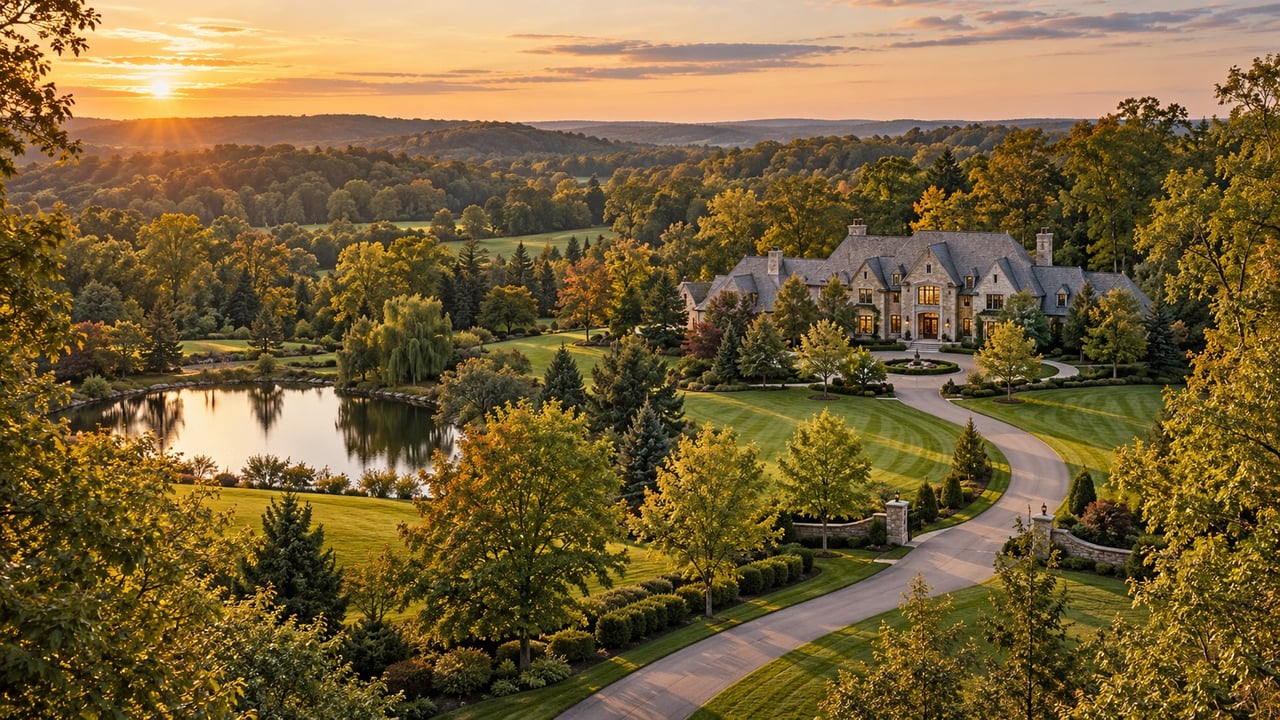
Hunting Valley is characterized by a low-density residential landscape where substantial acreage, long drives, architecturally distinctive residences and estate-scale properties can play an important role in value.
Unlike a conventional subdivision market, two Hunting Valley properties with similar square footage may be dramatically different assets. One may include significant usable acreage, guest accommodations, a pool house, barns or recreational facilities, while another may derive much of its value from architecture, renovation quality, privacy or a particularly strong setting.
Hunting Valley’s principal single-residential zoning district generally requires at least five acres for newly created parcels, although previously recorded lots and other zoning classifications may differ. Buyers should therefore verify zoning and parcel-specific requirements rather than assuming every Hunting Valley property follows the same standard.
“homes for sale in Hunting Valley”
Why Do Buyers Also Look at Gates Mills?
Gates Mills occupies its own distinctive position within the Chagrin River Valley. The village describes itself through Western Reserve architecture, equestrian farms, river views and rolling terrain, and identifies its location as approximately 25 minutes east of Downtown Cleveland. Village of Gates Mills
For real estate buyers, Gates Mills can offer historic residences, larger homesites, wooded land, river-area properties, equestrian-oriented properties and custom estates. Its housing stock can feel markedly different from both Hunting Valley and Pepper Pike.
That does not make one community “better” than another. The relevant question is how the individual property compares in land, condition, architecture, location and long-term ownership requirements.
How Does Moreland Hills Fit Into the Corridor?
Moreland Hills is another independent village within the eastern Cleveland and Chagrin Valley area. Buyers comparing Hunting Valley and Gates Mills frequently encounter Moreland Hills during the same search because luxury and larger-lot properties can cross municipal lines while still competing within the same broader buyer pool.
The important issue is not to treat Moreland Hills as an extension of Hunting Valley. It has its own village government, zoning, tax structure and municipal requirements. Moreland Hills
For buyers, that means a property comparison should extend beyond the house itself. Parcel size, utilities, municipality, school district, taxes, road location, improvements and restrictions should all be verified property by property.
Where Does Pepper Pike Fit Into the Luxury Search?
Pepper Pike creates another type of alternative within the corridor. The city covers approximately 7.5 square miles and lies roughly 12 miles east of Downtown Cleveland, bordered generally by I-271, SOM Center Road, Cedar Road and Chagrin Boulevard. Pepper Pike
Its residential real estate includes custom homes, established luxury properties and homes on substantial wooded lots, but its physical pattern is not identical to Hunting Valley or Gates Mills. Buyers may encounter more conventional residential streets and cul-de-sacs in Pepper Pike while still finding larger custom properties and significant privacy.
For that reason, a buyer may compare a five-acre Hunting Valley estate with a highly renovated Pepper Pike home offering less acreage but a different combination of location, condition and convenience.
That is not an apples-to-apples comparison on a spreadsheet, but it may be a very real comparison in the mind of the buyer.
What About Novelty?
Novelty appears frequently in luxury searches near Hunting Valley, especially when buyers are looking east toward Geauga County.
One caution is particularly important: do not rely on the mailing address alone to determine exactly where a property is located for municipal, school, zoning or tax purposes. With any property carrying a Novelty mailing address, buyers should verify the actual township or municipality, school district, county records, taxes and applicable zoning using the individual parcel information.
That kind of verification matters throughout the corridor, but it is especially important when a familiar mailing name can obscure the governmental jurisdiction that actually controls the property.
Hunting Valley vs. Gates Mills vs. Pepper Pike: What Is the Difference?
This is one of the most useful questions a luxury buyer can ask, provided the comparison is based on the properties and municipalities rather than subjective judgments about who should live where.
Hunting Valley frequently enters the conversation when acreage, estate-scale settings and low-density residential property are priorities. Gates Mills can attract the same buyer through historic architecture, wooded land, the Chagrin River Valley landscape and equestrian oriented properties. Pepper Pike may enter the same search through substantial custom homes, wooded settings and its location within the eastern suburban network.
Moreland Hills and nearby estate areas can add still more alternatives.
The correct answer is therefore not that one location is universally better.
The better question is:
Which property gives this particular buyer the strongest combination of land, house, location, condition, infrastructure and long-term ownership characteristics?
That is both a better real estate question and a much more accurate way to compare luxury properties.
Do Buyers Need to Think About Wells and Septic Systems?
Absolutely — depending on the property.
Estate ownership may involve systems and improvements that buyers of conventional suburban homes do not encounter as frequently. Depending on the location, a property may have a private well, septic system, drainage infrastructure, ponds, streams, culverts, long private drives, bridges, barns, guesthouses, pools, generators or other specialty improvements.
These are not reasons to avoid an estate property. They are reasons to understand exactly what is being purchased.
A beautifully renovated home on ten acres is more than a house. It is a residential property with land, infrastructure and potentially multiple systems that should be investigated individually.
Can Buyers Keep Horses or Build Additional Structures?
Possibly, but this should never be assumed from acreage alone.
Large lots throughout the Hunting Valley corridor may include barns, paddocks, guesthouses, pool houses, carriage houses or other accessory structures. Whether a buyer can construct something new, expand an existing structure, use land for equestrian purposes or divide a parcel depends on the specific municipality or township, zoning classification, lot characteristics, deed restrictions and other applicable regulations.
A five-acre or ten-acre parcel does not automatically mean it can be subdivided.
Likewise, the existence of a barn does not by itself establish what future uses are permitted.
Buyers considering substantial alterations should verify the applicable regulations with the governmental authority and appropriate professional advisers before purchasing.
How Should Buyers Evaluate Property Taxes Across the Corridor?
Property taxes should be evaluated at the parcel level, not by relying on a broad statement that one community is “high tax” or “low tax.”
A property's tax obligation can be influenced by county, municipality, school district, assessed value, exemptions and other factors. Even neighboring homes can have different tax histories.
Hunting Valley provides a particularly useful example. The village repealed its municipal income tax effective January 1, 2003, but property taxes and other obligations still apply and vary by the individual property.
For buyers comparing two estates, the correct approach is to obtain the actual tax information for each parcel and understand what is included rather than making assumptions based on community reputation.
What School District Serves a Hunting Valley Corridor Property?
This is another question that should be answered address by address.
A real estate description should not characterize one school as “better,” “worse,” “top,” or “best” for a particular buyer. Instead, buyers should verify the public school district assigned to the individual property using official sources and then independently research whatever educational information matters to them.
The same principle applies when buyers ask about private schools. An agent can identify geographic proximity or provide objective resources, but the buyer should evaluate educational options based on their own criteria.
This approach gives buyers useful information while avoiding subjective neighborhood steering.
How Close Is the Hunting Valley Corridor to Cleveland?
Distance varies materially depending on where the property sits within the corridor and where the buyer needs to travel.
University School describes its Hunting Valley campus as approximately 15 miles east of Downtown Cleveland, while Gates Mills describes itself as approximately 25 minutes east of downtown. Pepper Pike identifies its city as approximately 12 miles east of Downtown Cleveland. Actual drive times can vary substantially based on the individual property, destination, route, weather and traffic.
For relocation buyers, the better strategy is to test the actual drive from the property being considered to the places they expect to visit frequently rather than relying on a generalized commute estimate.
What Does a Luxury Buyer Need to Inspect Beyond the House?
For estate properties, due diligence should extend beyond kitchens, bathrooms and mechanical systems.
Buyers may need to evaluate the residence, roof, masonry, windows, electrical systems, HVAC, water source, septic, drainage, retaining structures, driveway, bridges or culverts, pool equipment, outbuildings, generators, landscaping infrastructure and any recreational improvements.
Land itself can also require investigation. Topography, wetlands, streams, easements, conservation restrictions, zoning, deed restrictions and the location of utilities may affect how the property can be used in the future.
This is one reason distinctive estates cannot always be compared solely by price per square foot.
The land and supporting improvements may represent a substantial part of what the buyer is actually purchasing.
Why Can Similar Sized Luxury Homes Have Very Different Values?
Because square footage is only one component of value.
Consider two 8,000-square-foot homes. One might occupy two acres and require extensive updating. Another may sit on ten landscaped acres with a pool house, guest accommodations, generator, renovated systems, recreational amenities and an additional parcel.
The living-area calculation may look similar.
The assets are not.
That is why automated valuations can struggle in markets such as Hunting Valley, Gates Mills, Novelty and the surrounding luxury corridor. Your existing estate-value analysis makes the same point: acreage, architecture, privacy, additional parcels, renovations and specialty improvements can create dramatic differences between properties that appear similar in basic real estate data.
What Is My Hunting Valley Area Estate Worth in 2026?
Why Replacement Reality Matters in the Hunting Valley Luxury Corridor
One of the most overlooked questions in luxury real estate is:
What would it take to recreate this property today?
That does not mean replacement cost determines market value. Buyers ultimately decide what they are willing to pay.
But replacement reality can provide important context when a property includes substantial acreage, mature landscaping, additional parcels, extensive renovations, a pool house, barns, recreational facilities or other improvements that would require significant money and time to reproduce.
This is especially relevant in an estate market where the next comparable property may not become available for months or years.
A distinctive property may therefore need to be evaluated not only against what recently sold, but against what the buyer can realistically purchase instead.
How to Spot a Rare Luxury Buying Opportunity Near Hunting Valley
What Should Buyers Know About Market Time on Luxury Estates?
A luxury estate can remain on the market longer than a conventional home without that fact alone establishing that something is wrong with the property.
The potential buyer pool becomes smaller as price, acreage, architectural style and specialized features become more specific. A ten-acre estate with a pool house and equestrian facilities is not competing for exactly the same buyer as a renovated luxury home on a smaller residential lot.
That means market time should be interpreted together with price history, property condition, competition and the uniqueness of the asset.
Why Some Luxury Homes Take Longer to Sell in Greater Cleveland
Should Buyers Search Beyond Hunting Valley?
For many luxury buyers, yes.
Someone who wants a specific municipality may choose to remain within that boundary. But a buyer whose priorities are acreage, privacy, architecture, a first-floor primary suite, guest accommodations, an additional parcel, pool, barn or recreational amenities may find that the strongest property appears several miles away.
This is why we encourage buyers to define the property first and the map second.
That does not mean ignoring location. Location remains fundamental. It means understanding which aspects of location actually matter to the individual buyer and comparing properties accordingly.
The eventual choice may be Hunting Valley.
It may be Gates Mills.
It may be Moreland Hills.
It may be Pepper Pike.
It may carry a Novelty mailing address.
The goal is not to steer a buyer toward any one community. The goal is to give them objective information about the properties available so they can make their own informed decision.
What Should Sellers Understand About the Hunting Valley Luxury Corridor?
The same cross-shopping behavior affects sellers.
A Hunting Valley seller is not necessarily competing only with other Hunting Valley listings. A buyer at that price level may also be looking at Gates Mills, Moreland Hills, Pepper Pike, Novelty, Chagrin Falls-area properties or another eastern Cleveland estate.
That means the most important comparable is not always the property closest geographically.
Sometimes the more relevant comparison is the estate that offers a similar combination of acreage, architecture, renovation quality, pool, guest accommodations, recreational amenities or overall lifestyle infrastructure.
This is why luxury pricing requires both closed-sale analysis and competitive-positioning analysis.
Closed sales tell us what buyers paid.
Current listings tell us what today's buyer can choose instead.
The Luxury Home Experts’ Take
The Hunting Valley luxury corridor is valuable as a real estate concept precisely because luxury buyers do not always search according to municipal boundaries. Hunting Valley, Gates Mills, Moreland Hills, Pepper Pike, Novelty and neighboring estate markets can overlap in the eyes of a buyer while remaining very different governmental jurisdictions and very different real estate environments.
Understanding those differences matters.
The strongest luxury purchase is not simply the largest house or the property with the most acreage. It is the property where location, land, architecture, condition, infrastructure, amenities, ownership responsibilities and price align with what the buyer actually values.
For sellers, the same principle works in reverse. The goal is not simply to tell the market that an estate is large or luxurious. The goal is to explain why that particular property would be difficult to duplicate and why it deserves consideration against everything else the buyer can purchase.
That is where strategy begins.
Hunting Valley Luxury Corridor FAQ
What is the Hunting Valley luxury corridor?
It is an informal real estate description for the luxury and estate market surrounding Hunting Valley and nearby eastern Cleveland and Chagrin Valley communities that buyers frequently compare. It is not an official municipality or government district.
What communities are commonly compared with Hunting Valley?
Depending on the buyer's search, properties in Gates Mills, Moreland Hills, Pepper Pike, Novelty, Chagrin Falls-area communities and other nearby estate markets may compete with Hunting Valley homes.
Is Hunting Valley the same as Gates Mills?
No. Hunting Valley and Gates Mills are separate incorporated villages with their own governments, zoning and property requirements.
Is Pepper Pike part of Hunting Valley?
No. Pepper Pike is a separate city. It may appear in the same luxury home search because buyers frequently compare properties across neighboring eastern communities. Pepper Pike
Does every Hunting Valley home have at least five acres?
No. Hunting Valley's principal single-residential zoning district generally requires a five-acre minimum for newly created parcels, but previously recorded parcels and other zoning classifications may differ. Buyers should verify the individual property.
Do Hunting Valley homes have wells and septic systems?
Some properties may. Utility arrangements should be verified individually during the property search and due-diligence process.
Can buyers keep horses in the Hunting Valley corridor?
Some properties may offer equestrian facilities or zoning that accommodates certain uses, but acreage alone does not establish that a particular use is permitted. Buyers should verify zoning, deed restrictions and applicable regulations for the specific parcel.
Can a large property be subdivided?
Not automatically. Lot size, frontage, zoning, utilities, conservation restrictions, deed restrictions and government approvals can all affect whether division or additional construction is possible.
Which school district serves Hunting Valley?
School assignments can vary by location. Buyers should verify the district associated with the specific property through official sources rather than relying on a general neighborhood description.
Are property taxes lower in Hunting Valley than nearby communities?
Property taxes should be compared property by property. Hunting Valley repealed its municipal income tax in 2003, but property taxes and other obligations still apply and vary according to the individual parcel and taxing jurisdictions.
How should buyers compare Hunting Valley with Gates Mills or Pepper Pike?
Compare objective property characteristics: location, acreage, architecture, condition, municipal services, utilities, zoning, taxes, infrastructure, amenities and the costs associated with owning the individual property. The answer will depend on the particular homes being considered rather than a blanket judgment about one community.
Why are luxury estates difficult to value?
Luxury homes may have few true comparables. Acreage, additional parcels, architecture, guest structures, renovations, pools, barns, recreational amenities, privacy and replacement difficulty can create significant differences between superficially similar properties.
Buying or Selling in the Hunting Valley Luxury Corridor?
Whether you are considering a Hunting Valley estate, comparing homes in Gates Mills, Moreland Hills or Pepper Pike, evaluating a property with a Novelty mailing address, or preparing a distinctive Northeast Ohio estate for sale, the analysis should begin with the individual property.
Mark and Denise Zervos and The Luxury Home Experts at Platinum Real Estate bring decades of Greater Cleveland real estate experience to the valuation, positioning, marketing and negotiation of distinctive homes throughout the eastern luxury corridor.
Explore the property. Understand the market. Make the decision with the right information.
216-990-2100 | 239-264-1100
Mark & Denise Zervos | The Luxury Home Experts at Platinum Real Estate
Global Reach. Local Roots.
References & Methodology
This article uses municipal information and property-market observations to explain the informal Hunting Valley luxury corridor. The phrase “Hunting Valley luxury corridor” is used as a real estate and geographic description and should not be interpreted as an official municipal, governmental, school or taxing district.
Municipal boundaries, zoning, school assignments, taxes, utilities, permitted uses and property restrictions should always be verified for the individual property through the appropriate government agencies and professional advisers. References to communities are based on geography, real estate characteristics and observable property considerations, not the demographic composition of residents or a judgment about which community a buyer should choose.
Official municipal information was consulted for Hunting Valley-area communities including Gates Mills, Moreland Hills and Pepper Pike, along with existing Luxury Home Experts neighborhood and market content.