Hunting Valley is one of Northeast Ohio’s most private and architecturally significant residential communities. Grand estates, wooded acreage, historic homes, equestrian properties and long private drives create a landscape that feels far removed from conventional suburbia, yet Cleveland’s eastern business, medical and cultural destinations remain accessible. Incorporated in 1924, Hunting Valley encompasses approximately eight square miles within the Chagrin River Valley. The village describes its identity through picturesque scenery, land conservation and a rural heritage closely connected to Greater Cleveland.
Hunting Valley is not built around a traditional downtown, dense subdivisions or commercial corridors. Its defining experience is residential: substantial land, natural screening, understated roads and homes positioned to take advantage of privacy, architecture and the surrounding landscape.
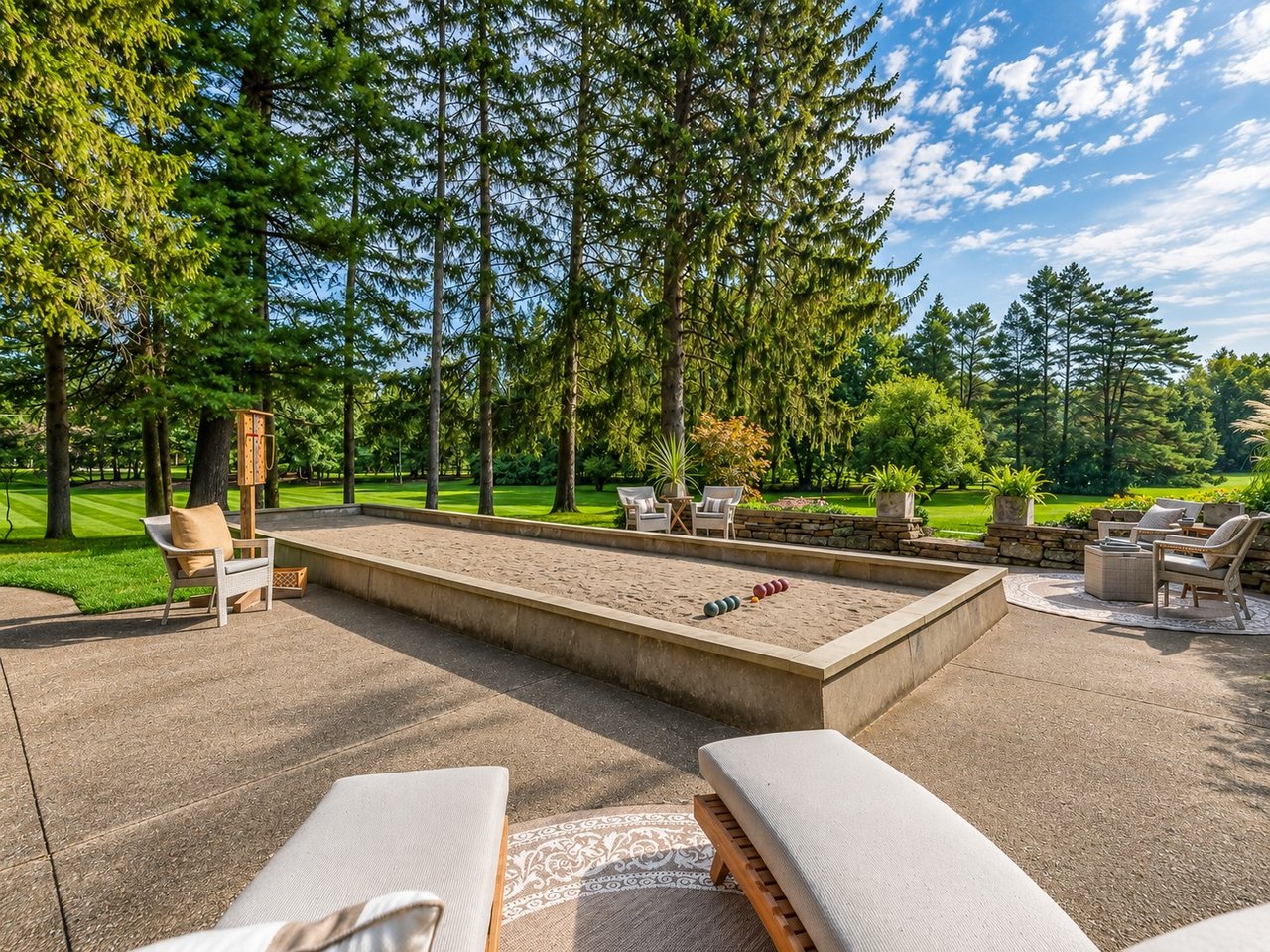
The approach to a Hunting Valley home is often part of the property’s appeal. Gated entrances, winding drives, mature trees, open lawns and stone walls can create a sense of arrival well before the residence comes into view. Some properties are surrounded by dense woodland, while others overlook fields, ponds, streams or rolling terrain. Homes may sit on five acres, ten acres or significantly more, with room for gardens, pools, outdoor entertaining, equestrian facilities, guest accommodations and recreational amenities. Hunting Valley’s principal single-residential zoning district generally requires a minimum lot area of five acres for newly created parcels. Previously recorded lots and properties in other zoning districts may differ, so five acres should not be assumed for every address. The village also uses conservation and historic settlement zoning classifications to help preserve its overall land-use character. This low-density pattern makes land quality as important as interior square footage. Privacy, usable acreage, road placement, topography, drainage, architecture and the condition of supporting improvements can all influence value.
Hunting Valley real estate includes historic country estates, architect-designed residences, equestrian properties, renovated traditional homes, contemporary architecture and newer custom construction.
Properties may offer:
A historic residence, a modern glass-and-stone home and an equestrian estate cannot be valued through the same formula. Even similarly sized properties may occupy entirely different market positions because of their land, privacy, design, condition and additional structures. Total acreage also does not necessarily equal usable acreage. Wetlands, streams, wooded slopes, conservation restrictions, setbacks, septic areas and drainage patterns may affect future additions or improvements.
Hunting Valley’s architecture is remarkably varied. Buyers may encounter traditional country houses, Georgian and Tudor-inspired estates, Western Reserve influences, mid-century residences and contemporary custom homes designed around natural light and views.
Older properties may include exceptional craftsmanship, millwork, masonry and room proportions, but they can also contain systems and additions completed during several different eras. A beautifully updated interior should be evaluated alongside the roof, windows, masonry, electrical service, plumbing, heating and cooling, waterproofing and structural components.
New construction and significant exterior changes are carefully reviewed. The Hunting Valley Building Department issues construction and renovation permits, performs inspections and provides planning and zoning support. The department also oversees Architectural Board of Review and Planning and Zoning submission processes intended to preserve the village’s aesthetic quality and character.
Hunting Valley’s acreage and rural heritage make it particularly notable for equestrian real estate. Village zoning permits private stables under specific requirements. In the primary residential district, private stables may generally accommodate no more than one horse for every two acres of lot area and are subject to substantial setbacks from roads, property lines and other buildings. Buyers should confirm all current regulations directly with the village for the individual property and intended use.
An equestrian property should be evaluated beyond the appearance of the barn. Important considerations include pasture condition, drainage, fencing, water supply, electrical systems, ventilation, stall construction, equipment storage, trailer access and the ongoing maintenance demands of the land. Existing horse facilities also do not guarantee that every expansion, arena or new outbuilding will be approved. Zoning, lot coverage, setbacks and site conditions remain property-specific.
Land conservation is central to Hunting Valley’s identity. The village highlights its picturesque landscape and conservation priorities, and it has undertaken projects involving tree-canopy improvement, invasive-growth removal, streambank stabilization and new tree plantings on village-owned land. For homeowners, protected scenery can contribute meaningfully to privacy and long-term desirability. It can also introduce restrictions involving streams, wetlands, tree removal, conservation easements or future development.
Buyers should review deeds, surveys, easements and environmental information rather than assuming that all acreage can be cleared, divided or improved. For sellers, accurately explaining protected land and usable acreage is essential to positioning the property correctly.
Hunting Valley intentionally contains very little commercial development, but it is close to the restaurants, boutiques and community activity of Chagrin Falls. The historic village center features more than 75 independent shops and restaurants, along with the falls, parks and seasonal events that make it one of the Chagrin Valley’s most recognizable destinations. Additional shopping, dining and services are available in Gates Mills, Moreland Hills, Pepper Pike, Orange Village, Beachwood and Woodmere. Nearby destinations include Sara’s Place by Gavi’s in Gates Mills, Pinecrest, Eton Chagrin Boulevard, Legacy Village and Beachwood Place. This proximity allows Hunting Valley to retain its private, low-density environment without leaving residents disconnected from groceries, dining, professional services, medical care or regional shopping.
SOM Center Road, Fairmount Boulevard, South Woodland Road, Shaker Boulevard and Chagrin River Road provide connections toward Chagrin Falls, Gates Mills, Moreland Hills, Pepper Pike and the wider eastern suburbs. The village’s own description emphasizes its rural setting alongside access to Greater Cleveland’s business, cultural and social life. University School describes its Hunting Valley campus as approximately 15 miles east of Downtown Cleveland. Actual drive times depend on traffic, weather and the location of the individual property. Hunting Valley repealed its municipal income tax effective January 1, 2003. Property taxes and other tax obligations still apply and can vary by county, school district and parcel, so buyers should obtain property-specific tax information before purchasing.
Buying in Hunting Valley requires evaluating the complete estate, not just the residence.
Important considerations may include:
The village performs residential property-maintenance and pre-sale home inspections. Buyers and sellers should understand the applicable process early, particularly when a property contains multiple structures or substantial improvements.
Selling a Hunting Valley home requires far more than listing its square footage and acreage. The marketing must communicate the property as a complete experience: the entrance, architecture, privacy, usable land, landscaping, outdoor living, views and supporting structures. Buyers need to understand why the estate is different and what cannot be easily duplicated. A historic residence should be positioned around its architecture, craftsmanship and thoughtfully completed improvements. A contemporary home may require imagery that highlights natural light, scale and connection to the landscape. An equestrian estate needs a clear presentation of barns, paddocks, pasture layout, utilities and access. Professional aerial photography, architectural imagery, seasonal landscapes and carefully executed twilight photography are especially valuable in Hunting Valley. A standard exterior photo rarely communicates the scope of a private estate.
Hunting Valley is one of the clearest examples of why automated valuations and general suburban comparisons are not enough. Two properties with similar interior square footage may differ dramatically in value because of usable acreage, privacy, architecture, renovation quality, utilities, conservation restrictions and additional structures. A ten-acre property with difficult terrain may compete differently from a smaller estate with exceptional usable land and a fully renovated residence. In a market where respected agents already have strong local roots, authority must be earned through precision, strategy and results. Mark and Denise Zervos combine neighborhood level knowledge from agents rooted throughout Cleveland’s eastern suburbs and the Chagrin Valley with sophisticated estate positioning, professional storytelling, targeted digital exposure and access to buyers across premier lifestyle markets. For sellers, that means identifying what is genuinely irreplaceable and building the marketing around it. For buyers, it means examining the home, land, systems, improvements and restrictions before placing a value on the property.
Whether you are searching for a historic estate, contemporary residence, equestrian property or private home on substantial acreage, Mark and Denise Zervos of The Luxury Home Experts at Platinum Real Estate provide strategic representation backed by detailed market analysis, locally rooted expertise and sophisticated property marketing.
For sellers, Mark and Denise create a presentation that communicates the architecture, privacy, land and lifestyle advantages that make the estate genuinely different. For buyers, they help evaluate condition, acreage, utilities, improvements, restrictions and long-term ownership responsibilities before moving forward.
The Luxury Home Experts at Platinum Real Estate
216-990-2100
239-264-1100
Strategic real estate representation across premier lifestyle markets.
780 people live in Hunting Valley Ohio, where the median age is 55 and the average individual income is $159,228. Data provided by the U.S. Census Bureau.
Total Population
Median Age
Population Density Population Density This is the number of people per square mile in a neighborhood.
Average individual Income
There's plenty to do around Hunting Valley Ohio, including shopping, dining, nightlife, parks, and more. Data provided by Walk Score and Yelp.
Explore popular things to do in the area, including Hsu Roger Y K, Broadway Bagels, and Landerwood Plaza.
| Name | Category | Distance | Reviews |
Ratings by
Yelp
|
|---|---|---|---|---|
| Dining | 2.11 miles | 0 reviews | 0/5 stars | |
| Dining | 2.93 miles | 0 reviews | 0/5 stars | |
| Shopping | 2.84 miles | 0 reviews | 0/5 stars | |
| Shopping | 2.9 miles | 0 reviews | 0/5 stars | |
| Shopping | 3.17 miles | 0 reviews | 0/5 stars | |
| Shopping | 3.29 miles | 0 reviews | 0/5 stars | |
| Active | 1.53 miles | 0 reviews | 0/5 stars | |
| Beauty | 2.78 miles | 1 review | 5/5 stars | |
| Beauty | 2.78 miles | 41 reviews | 3.3/5 stars | |
| Beauty | 2.9 miles | 0 reviews | 0/5 stars | |
| Beauty | 2.9 miles | 0 reviews | 0/5 stars | |
| Beauty | 2.97 miles | 0 reviews | 0/5 stars | |
| Beauty | 3.01 miles | 0 reviews | 0/5 stars | |
| Beauty | 3.08 miles | 0 reviews | 0/5 stars | |
| Beauty | 3.16 miles | 0 reviews | 0/5 stars | |
| Beauty | 3.16 miles | 0 reviews | 0/5 stars | |
| Beauty | 3.17 miles | 0 reviews | 0/5 stars | |
| Beauty | 3.18 miles | 0 reviews | 0/5 stars | |
| Beauty | 3.22 miles | 0 reviews | 0/5 stars | |
| Beauty | 3.22 miles | 0 reviews | 0/5 stars | |
| Beauty | 3.22 miles | 0 reviews | 0/5 stars | |
| Beauty | 3.22 miles | 0 reviews | 0/5 stars | |
| Beauty | 3.26 miles | 0 reviews | 0/5 stars | |
| Beauty | 3.3 miles | 1 review | 1/5 stars | |
|
|
||||
|
|
||||
|
|
||||
|
|
||||
|
|
||||
|
|
Hunting Valley Ohio has 301 households, with an average household size of 2.59. Data provided by the U.S. Census Bureau. Here’s what the people living in Hunting Valley Ohio do for work — and how long it takes them to get there. Data provided by the U.S. Census Bureau. 780 people call Hunting Valley Ohio home. The population density is 99 and the largest age group is Data provided by the U.S. Census Bureau.
Total Population
Population Density Population Density This is the number of people per square mile in a neighborhood.
Median Age
Men vs Women
Population by Age Group
0-9 Years
10-17 Years
18-24 Years
25-64 Years
65-74 Years
75+ Years
Education Level
Total Households
Average Household Size
Average individual Income
Households with Children
With Children:
Without Children:
Marital Status
Blue vs White Collar Workers
Blue Collar:
White Collar: