Hudson offers one of Northeast Ohio’s most recognizable combinations of historic character, established residential neighborhoods, natural beauty, shopping, dining, parks, and convenient access to both Cleveland and Akron. Located in northern Summit County, Hudson feels rooted in the traditions of the Connecticut Western Reserve. Its historic village greens, century homes, churches, tree-lined streets, and carefully preserved downtown create a setting that is immediately recognizable, yet the community also includes newer construction, contemporary residences, condominiums, planned neighborhoods, and substantial estate properties.
The present-day City of Hudson was formed when the former City of Hudson and Hudson Township merged on January 1, 1994. That merger brought the historic village center and the more spacious township areas into one municipality, helping explain why Hudson real estate can range from homes within distance of downtown to properties with wooded acreage, ponds, long driveways, and greater separation from neighboring residences.
Hudson’s position between Cleveland and Akron is another important part of its appeal. Residents can enjoy the atmosphere of a historic small city while remaining connected to employment centers, healthcare systems, universities, airports, shopping districts, cultural institutions, and recreational destinations throughout Northeast Ohio.
People are drawn to Hudson because it offers several different experiences within one community. Near downtown, homes are connected to the village greens, locally owned shops, restaurants, cafés, community events, and the historic architecture that defines central Hudson. In other parts of the city, buyers may find quiet residential streets, established subdivisions, newer neighborhoods, golf-course settings, wooded properties, and larger homesites. Hudson feels polished without appearing manufactured. Its character comes from a combination of authentic historic buildings, preserved homes, established trees, public greens, brick walkways, parks, independent businesses, and architecture developed over more than two centuries.
The community also offers a level of everyday activity that many smaller residential cities do not. Residents can stroll through downtown, attend a farmers market or outdoor concert, explore the parks, dine locally, play golf, enjoy a lake, or access regional trails and protected natural areas without leaving the broader Hudson area. The city describes its downtown as a combination of historic neighborhoods, shopping, dining, village greens, and pedestrian oriented activity.
Hudson homes and real estate include historic residences, traditional suburban homes, ranches, Cape Cods, Colonials, contemporary properties, custom built residences, newer construction, condominiums, and substantial private estates. Near the historic downtown district, buyers may encounter century homes with original architectural details, front porches, wood floors, detailed millwork, fireplaces, carriage-house influences, and close proximity to Main Street and the village greens. Farther from downtown, the housing landscape becomes increasingly varied. Some properties are located within established neighborhoods with sidewalks, community entrances, ponds, and shared amenities. Others offer wooded settings, larger parcels, long driveways, expansive lawns, swimming pools, outdoor entertaining areas, additional garages, or greater privacy.
Architectural styles may include Federal, Greek Revival, Colonial Revival, Georgian-inspired, tudor, cape cod, ranch, transitional, contemporary, and fully custom designs. The city’s long history means that properties built during very different periods may be located relatively close to one another. That diversity makes Hudson difficult to value through square footage alone. A carefully preserved historic residence near downtown may compete differently than a newer custom home, a golf-course property, a condominium, or an acreage estate. Important value considerations include architecture, renovation quality, location, homesite, privacy, proximity to downtown, property condition, school assignment, outdoor amenities, utility configuration, and the relationship between the home and its surrounding neighborhood.
Hudson takes an active role in preserving its historic architecture and downtown character. The city’s historic district includes residential and commercial properties, and Hudson’s Architectural and Historic Board of Review oversees exterior changes affecting designated historic structures. Work that replaces exterior materials or alters the appearance of a historic property may require city review and approval. For buyers, a historic Hudson home may offer craftsmanship, character, architectural significance, and a location that cannot be recreated. It may also require a more detailed evaluation of roofing, windows, foundations, electrical systems, plumbing, insulation, drainage, masonry, original materials, and previous renovations.
Buyers should understand which elements of the property are historically regulated before planning additions, replacement windows, exterior alterations, garages, fences, or other visible improvements.
For sellers, historic significance can be a major marketing advantage when the home’s architecture, history, renovations, and relationship to downtown are presented properly. Simply calling a property “historic” is not enough. The marketing should explain what makes the residence distinctive and how its original character has been preserved or thoughtfully adapted.
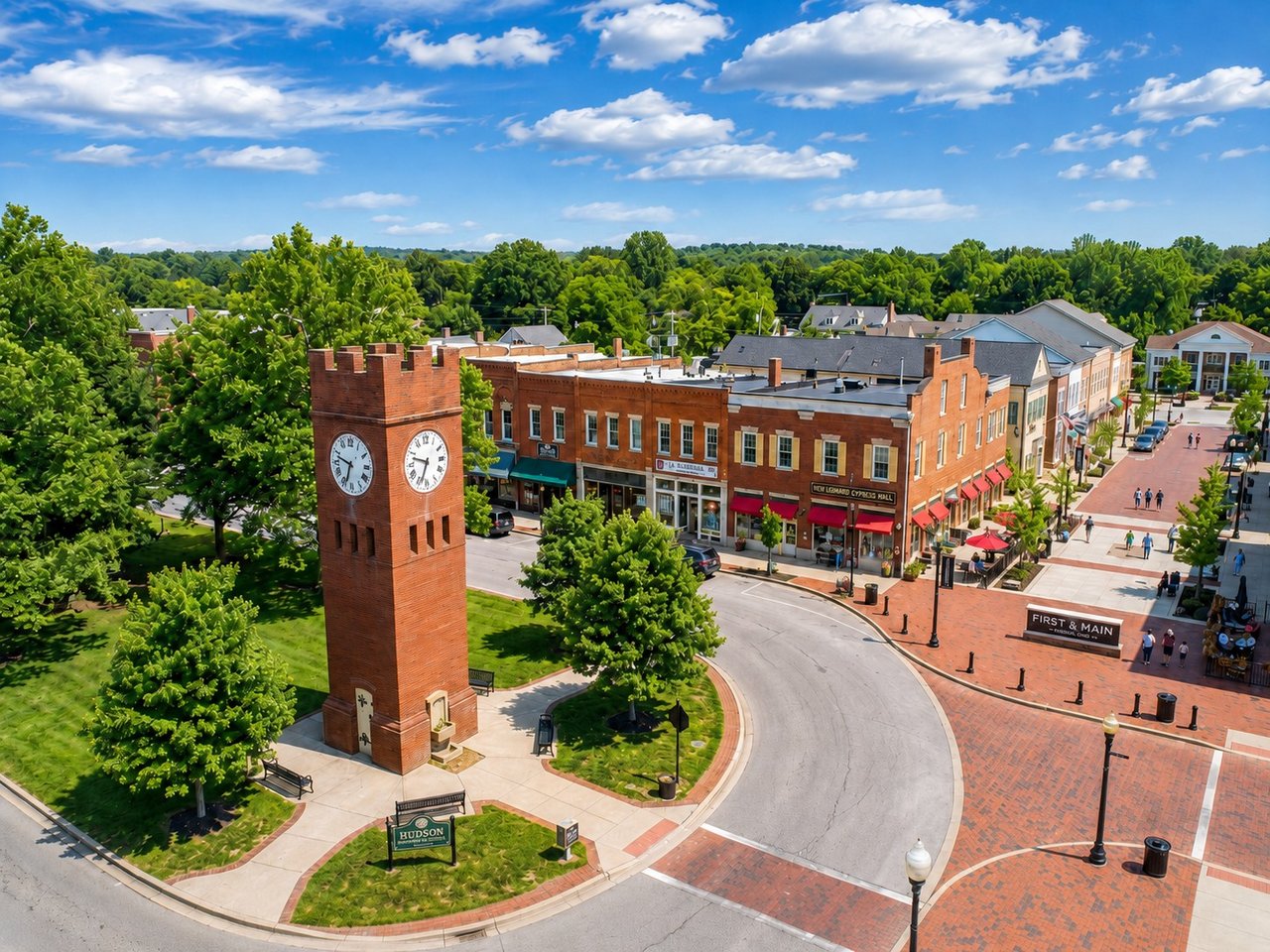
Downtown Hudson is centered around Main Street, the Clocktower Green, the Gazebo Green, historic Town Hall, traditional storefronts, restaurants, churches, and residential streets lined with mature trees and period architecture. The village greens create a visual and social center for the community. They host seasonal activities, concerts, community gatherings, art events, and the Hudson Farmers Market, which brings Northeast Ohio produce and specialty-food vendors downtown during its operating season. The relationship between downtown and the surrounding residential streets is one of Hudson’s strongest real estate differentiators. Some buyers specifically seek the ability to walk to shops, dining, coffee, events, Western Reserve Academy, and the village greens. Homes within this area can differ considerably in lot size, renovation level, parking, garage configuration, historic restrictions, and proximity to downtown activity. Those factors should be evaluated individually rather than treating every downtown Hudson property as equivalent.
First & Main extends Hudson’s traditional downtown experience with a pedestrian-oriented shopping and dining district connected to historic Main Street and the city greens. The development includes a combination of national retailers, locally owned businesses, restaurants, gathering spaces, and the First & Main Green. The broader Hudson shopping and dining area includes more than 100 independently owned, regional, and national stores and restaurants. Current downtown dining options include Hudson’s Restaurant, Downtown 140, Rosewood Grill, Kepner’s Tavern, and additional cafés, casual restaurants, specialty-food businesses, and locally operated establishments. Restaurant and retail tenants can change, so current availability should always be confirmed directly. First & Main and the surrounding downtown also host seasonal entertainment, including outdoor music and community events on the green. This creates a more active downtown environment than buyers may expect from a city with Hudson’s historic appearance.
Hudson Springs Park is one of the city’s defining outdoor destinations. The 260-acre park is centered around a picturesque 50-acre lake used for fishing and non motorized boating. A nearly two mile wooded loop circles the lake, and the park also includes an 18-hole disc-golf course, a playground, picnic pavilions, bocce, sand volleyball, open recreation areas, and access points from surrounding neighborhoods. The park provides a different experience from a conventional athletic complex. The lake, woods, meadow, trails, and wildlife create a setting used for walking, running, paddling, fishing, picnicking, and nature observation. For some homebuyers, proximity or trail access to Hudson Springs Park may be a meaningful lifestyle feature. However, buyers should also evaluate traffic patterns, park access, neighboring public land, and seasonal activity when considering a home near a major recreational area.
Barlow Farm Park is a 60-acre city recreation complex offering baseball and softball fields, soccer facilities, pickleball, tennis, playground equipment, pavilions, and other active recreational amenities. Nearby Case Barlow Farm preserves an important part of Hudson’s agricultural and abolitionist history. Chauncey and Cleopatra Case arrived in Hudson in 1814, and the property remained associated with the Case and Barlow families for generations. The surviving farmhouse, bank barn, gardens, and additional structures are now operated by a nonprofit organization dedicated to historic preservation and community engagement.vThe farm’s history includes connections to abolitionist activity and the Underground Railroad. The property’s preserved buildings and grounds provide a tangible link to the agricultural landscape that once surrounded much of Hudson.
Hudson maintains 20 parks and approximately 1,128 acres devoted to active recreation, passive recreation, conservation, and preservation. Amenities across the system include walking trails, playgrounds, picnic areas, fishing, boating, athletic fields, community gardens, disc golf, and natural open space. In addition to Hudson Springs and Barlow Farm Park, residents can explore neighborhood parks, preserved woods, walking paths, and conservation properties throughout the city. Summit Metro Parks also operates Wood Hollow Metro Park on Barlow Road in Hudson. The park provides another wooded trail setting within the broader regional park system. Hudson is also positioned near Cuyahoga Valley National Park and the parks, trails, river landscapes, and historic canal resources found throughout the Cuyahoga Valley. This gives residents access to a much larger recreational network beyond the city’s own park system.
Ellsworth Meadows Golf Club is a city-owned, 18-hole public golf course located on Barlow Road. The City of Hudson purchased the former private course in 1997 to preserve the property as green space, and the renovated course opened in 1999. Its rolling terrain, tree-lined fairways, streams, ponds, bunkers, and contoured greens create a distinctive golf environment within the city. A new 6,000-square-foot clubhouse opened in 2025, expanding the course’s gathering, golf, and community facilities. Homes near the course may offer wooded surroundings, golf views, or convenient course access, but buyers should verify whether a property directly borders the course, is separated by preserved land, or is simply located within the surrounding area.
Hudson’s history is closely connected to the Connecticut Western Reserve, abolitionist activity, education, and the development of Northeast Ohio. David Hudson and other Connecticut settlers arrived in the area beginning in 1799. Hudson was incorporated in the nineteenth century and developed around the village-green plan that remains evident today. Western Reserve Academy traces its origins to Western Reserve College, founded in Hudson in 1826. The school’s approximately 190-acre campus includes historic Brick Row, academic buildings, residences, athletic fields, green spaces, and more than 40 structures within walking distance of downtown Hudson. The campus contributes substantially to Hudson’s architectural identity. Its historic buildings, lawns, mature trees, and relationship to nearby residential streets reinforce the New England-influenced character of central Hudson. Hudson is also associated with John Brown and the Underground Railroad. That history remains part of local interpretation, guided tours, historic properties, and the city’s broader identity.
Hudson is conveniently positioned between Cleveland and Akron, giving residents access to both metropolitan areas while maintaining a distinct community identity. Interstate 480, State Route 91, State Route 303, and the nearby Ohio Turnpike provide regional connections. The city’s location places it within reach of Stow, Twinsburg, Streetsboro, Aurora, Solon, Peninsula, Boston Heights, Cuyahoga Falls, Macedonia, and other Northeast Ohio communities.
Actual travel time varies significantly depending on the property, destination, route, traffic, construction, and weather. Buyers should evaluate daily travel from the specific home rather than relying solely on a general Hudson address.
Hudson City Schools provides PreK–12 public education through its early-learning, elementary, intermediate, middle, and high-school buildings. The district’s administrative offices are located on North Hayden Parkway. School-district boundaries and municipal boundaries do not always align perfectly. A Hudson mailing address or a property located near the city boundary should not be treated as final confirmation of school assignment. Buyers should verify the assigned school district, transportation arrangements, taxes, utilities, municipal jurisdiction, and service providers for the individual parcel directly through official records. Western Reserve Academy also provides a private boarding and day-school option for grades nine through postgraduate study on its historic Hudson campus.
Hudson properties do not all have identical infrastructure. Depending on location, water service may be supplied by Hudson, Akron, Stow, or Cleveland. Sewer availability, private septic systems, drainage, stormwater conditions, electric service, and other utility arrangements should be confirmed for the individual property. A downtown historic home may present very different infrastructure considerations from a newer subdivision property or an estate on a larger parcel. Buyers considering older homes should review foundations, masonry, roofing, electrical capacity, plumbing, windows, insulation, waterproofing, drainage, and the scope of prior renovations. Properties with larger homesites may require additional investigation of wells, septic systems, ponds, streams, wetlands, private drives, tree maintenance, retaining structures, generators, accessory buildings, and stormwater movement.
Buying a home in Hudson requires understanding which part of the market the property truly occupies. A historic downtown residence should be evaluated for architectural integrity, preservation requirements, parking, renovation quality, and proximity to downtown activity. A newer neighborhood home should be compared with similar construction, homesite quality, homeowner-association responsibilities, available builder inventory, and competing resale properties. An acreage or estate property requires closer examination of usable land, topography, drainage, privacy, outbuildings, utilities, maintenance responsibilities, and the feasibility of future improvements. Buyers should also consider what cannot be changed. Interior finishes can be renovated. The home’s setting, downtown proximity, lot configuration, neighboring uses, mature trees, road exposure, and fundamental architecture are far more difficult to reproduce. Experienced local representation can help distinguish between a property that simply carries a Hudson address and one that offers the right combination of location, condition, architecture, land, and long-term market appeal.
Selling a Hudson property requires positioning it against the correct competitive market.
A century home near the village greens should not be marketed like a conventional suburban residence. A newer custom home should be compared with both resale competition and available new construction. An acreage estate, golf-course property, condominium, and downtown residence may each require a different pricing and marketing strategy. The presentation should communicate what is difficult to duplicate.
For a historic home, that may be craftsmanship, architectural provenance, original details, thoughtful renovation, and walkability to downtown. For a newer residence, it may be floor plan design, construction quality, first floor living, technology, outdoor amenities, and low-maintenance systems. For an estate property, it may be privacy, acreage, mature landscaping, a pool, additional structures, extensive garage space, or proximity to protected open land.
Professional photography, aerial imagery, twilight photography, video, floor plans, architectural storytelling, and strategic digital exposure can help buyers understand the complete property rather than viewing it as a collection of individual rooms.
Pricing should reflect the home’s true competitive category, current buyer expectations, property condition, location, land, architecture, and the availability of comparable alternatives.
Hudson’s strongest real estate advantage is also what makes the market more complicated: the community offers many distinctly different ownership experiences.
A historic home close to Main Street, a traditional neighborhood property, a newer ranch, a condominium, a golf course residence, and a wooded estate may all carry a Hudson address while appealing to different buyers and competing against different properties.
For buyers, the goal is to understand not only what the home looks like today, but how its location, architecture, land, historic status, utility configuration, and surrounding environment may affect future ownership.
For sellers, successful positioning begins by identifying what Hudson buyers will value most about the specific property and building the pricing, presentation, and marketing around those distinctions.
Mark and Denise Zervos understand that buying or selling in Hudson requires careful attention to historic district considerations, downtown proximity, architectural quality, neighborhood differences, property infrastructure, acreage, school boundaries, and the features that influence long-term market value.
As The Luxury Home Experts at Platinum Real Estate, Mark and Denise provide strategic representation, sophisticated property marketing, detailed local research, and experienced guidance for buyers and sellers throughout Hudson and Northeast Ohio.
Whether you are considering a historic home near the village greens, a newer ranch, a custom residence, a condominium, a wooded property, or a substantial Hudson estate, work with local real estate professionals who understand how to evaluate and position the complete property.
Mark and Denise Zervos
The Luxury Home Experts
Platinum Real Estate
216-990-2100
239-264-1100
Luxury Real Estate Across Premier Lifestyle Markets
26,114 people live in Hudson Ohio, where the median age is 43 and the average individual income is $73,807. Data provided by the U.S. Census Bureau.
Total Population
Median Age
Population Density Population Density This is the number of people per square mile in a neighborhood.
Average individual Income
There's plenty to do around Hudson Ohio, including shopping, dining, nightlife, parks, and more. Data provided by Walk Score and Yelp.
Explore popular things to do in the area, including Perkins Restaurant & Bakery, The Spice & Tea Exchange, and Mary's Hallmark.
| Name | Category | Distance | Reviews |
Ratings by
Yelp
|
|---|---|---|---|---|
| Dining · $$ | 0.57 miles | 37 reviews | 3.1/5 stars | |
| Dining | 0.61 miles | 0 reviews | 0/5 stars | |
| Dining | 0.62 miles | 0 reviews | 0/5 stars | |
| Dining | 0.62 miles | 0 reviews | 0/5 stars | |
| Dining · $$$ | 0.63 miles | 24 reviews | 2.1/5 stars | |
| Dining | 0.63 miles | 49 reviews | 4.4/5 stars | |
| Dining | 0.64 miles | 2 reviews | 2/5 stars | |
| Dining | 0.64 miles | 0 reviews | 0/5 stars | |
| Dining · $ | 0.64 miles | 87 reviews | 3.6/5 stars | |
| Dining · $$ | 0.65 miles | 180 reviews | 4.2/5 stars | |
| Shopping | 0.59 miles | 0 reviews | 0/5 stars | |
| Shopping | 0.61 miles | 3 reviews | 3.3/5 stars | |
| Shopping | 0.62 miles | 0 reviews | 0/5 stars | |
| Shopping | 0.63 miles | 0 reviews | 0/5 stars | |
| Shopping | 0.65 miles | 1 review | 5/5 stars | |
| Active | 0.62 miles | 1 review | 4/5 stars | |
| Active | 0.66 miles | 0 reviews | 0/5 stars | |
| Active | 0.66 miles | 0 reviews | 0/5 stars | |
| Beauty | 0.62 miles | 2 reviews | 3/5 stars | |
| Beauty | 0.62 miles | 28 reviews | 3.8/5 stars | |
| Beauty | 0.62 miles | 1 review | 4/5 stars | |
| Beauty | 0.62 miles | 14 reviews | 3.4/5 stars | |
| Beauty | 0.66 miles | 0 reviews | 0/5 stars | |
|
|
||||
|
|
||||
|
|
||||
|
|
||||
|
|
||||
|
|
Hudson Ohio has 9,185 households, with an average household size of 2.8. Data provided by the U.S. Census Bureau. Here’s what the people living in Hudson Ohio do for work — and how long it takes them to get there. Data provided by the U.S. Census Bureau. 26,114 people call Hudson Ohio home. The population density is 815 and the largest age group is Data provided by the U.S. Census Bureau.
Total Population
Population Density Population Density This is the number of people per square mile in a neighborhood.
Median Age
Men vs Women
Population by Age Group
0-9 Years
10-17 Years
18-24 Years
25-64 Years
65-74 Years
75+ Years
Education Level
Total Households
Average Household Size
Average individual Income
Households with Children
With Children:
Without Children:
Marital Status
Blue vs White Collar Workers
Blue Collar:
White Collar: